


- Traore Playbook: Populist Legitimacy in the Age of Military Coups - 29 May, 2026
- Russian Strategy of Information Warfare in the Sahel - 14 April, 2026

What is happening?
While the digital transformation of the information ecosystem presents an immense opportunity to improve the quality and speed of knowledge-sharing, it has also become central to coordinated efforts to spread disinformation and propaganda. The Sahel region of Africa, torn by years of conflict and instability, presents in itself a perfect target for the exploitation of existing social tensions through weaponized usage of media campaigns. Russia appears to be the most active actor in the region, seeking to shape local politics through various tools of influence. In their 2024 report, Africa Center for Strategic Studies identified 189 disinformation campaigns continent-wide, out of which 80 were attributed to Russia, with a particular surge of activity in Sub-Saharan Africa. Through this, Russia seeks to facilitate political realignment of local governments, gain access to natural resources, and project a status of a global superpower.
The impact can hardly be overstated. France and the United States, traditional allies of several countries in the region, have seen their strategic position completely erode following a rapid succession of military coups. In parallel, Russia has emerged as a replacement and has become a central foreign partner for new governments, particularly in Niger, Burkina Faso, and Mali.
While multiple factors contributed to this geopolitical reorientation, Russian-sponsored information campaigns have played a notable role in shaping public opinion. Three primary channels of communication have been used to spread targeted narratives and influence political transformation: Russian state-affiliated conglomerates, locally managed African outlets, and grassroots movements.
Tool 1: Russian-owned Media Networks
The first pillar of Russian strategy is the use of elaborate state-owned media networks, such as Sputnik and RT, to report on local issues in domestic languages. Sahelian states are particularly vulnerable to this approach, as the journalistic sector in many countries remains underdeveloped and often constrained by restrictions on independent reporting. Reporters Without Borders (RSF), for instance, ranks Mali 119th out of 180 countries in its press freedom index, with a continuous decline after the 2021 coup. Such a media environment presents an opportunity for external actors such as Russia to fill the void with their own resources and, as a consequence, play a role in shaping the narratives on key social issues.
In their articles, both RT and Sputnik frequently use emotionally charged language to evoke anger, fear, or frustration with a specific objective to make readers, and more broadly society, highly antagonistic toward Western governments or initiatives in the region. In Niger, for instance, in the wake of the 2023 coup, coverage revolved around two themes: the perceived failure of French security efforts and the promotion of Russia as an alternative partner.
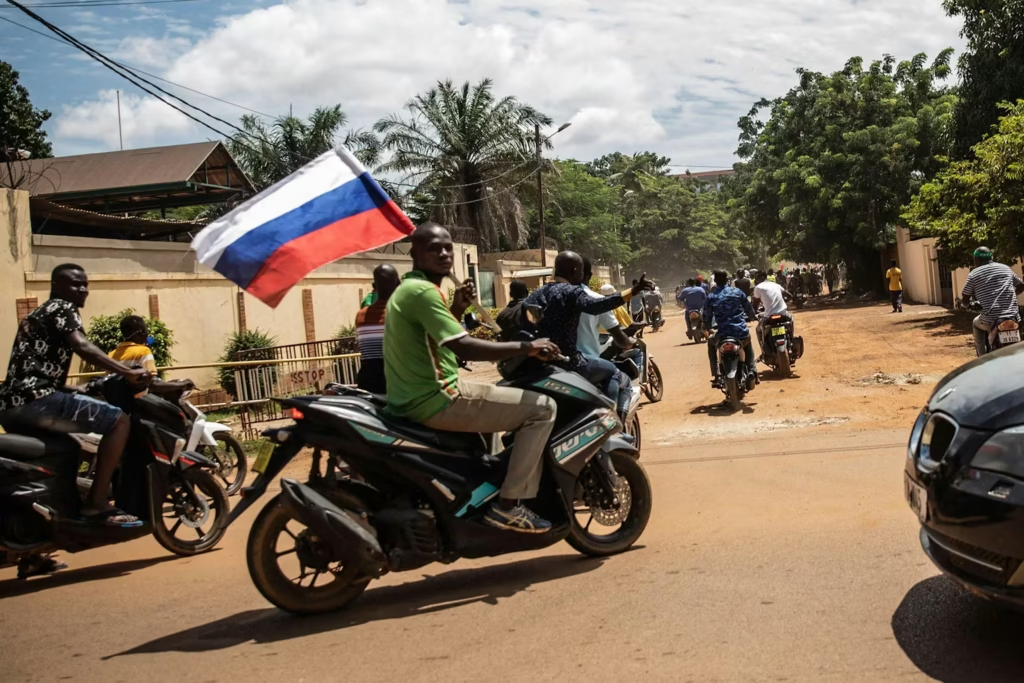
In many campaigns, some of the information provided appears to be fabricated. During the growing unrest in Mali, stories circulated accusing the United Nations of supporting attacks led by rebel forces and supplying equipment to terrorist groups. One deepfake depicting a supposed mass grave of civilians killed by French soldiers was particularly popular, contributing to increasing distrust of the MINUSMA peacekeeping mission. Existing French media was also portrayed as colonial, subsequently leading to its nationwide ban. At the same time, the Malian military was reported to have achieved decisive victories with the help of Russian mercenaries, despite limited evidence to support such claims.
Tool 2: Local Outlets
The second important component of the Russian toolkit targets the news organizations within the local management structure. One of the most influential among them, reporting on continent-wide topics, is Afrique Media TV. Founded only in 2011 in Cameroon, it has since then risen to prominence in the African media landscape and now has over a million subscribers on its Facebook page alone. Analysis conducted by the African Digital Democracy Observatory points to a deep connection between Afrique Media TV’s senior management and the Russian Wagner Group (recently rebranded as African Corps).
In its reporting, Afrique Media TV adopts talking points almost identical to those voiced in Moscow. Prominent narratives include criticism of NATO and other Western-led military initiatives, the glorification of the Russian mercenary forces, and the promotion of Africa-Russia partnership. Additionally, some stories appear to be constructed to suggest links between domestic terrorism, atrocities, and the West. In particular, the outlet has consistently popularized an idea of Boko Haram, a jihadist group originating from Nigeria, being sponsored by France to destabilize the region.
Similar to RT and Sputnik, Afrique Media TV has actively reported on the recent coups in the Sahel. While covering events in Burkina Faso leading up to the 2022 coup, the media emphasized the alleged inaction of foreign missions. This, according to the constructed narrative, was the main reason behind the spread of terrorist threats. In turn, the rising military junta and Russia were depicted as forces seeking to “liberate” the country and “restore peace”. While anti-French sentiment was present in the society regardless, such openly antagonistic language, often in combination with unverified accusations, contributed to growing demands for the withdrawal of French forces.
Tool 3: Grassroots Movements.
The third strategic approach used by Russia in the Sahel is the cultivation and operationalization of grassroots movements. In practice, this involves providing funding and media support to small local anti-Western organizations in exchange for promoting Russia as a legitimate partner. Code for Africa (CfA) identified at least 45 such movements across 19 African countries in its 2024 report. Most appear to follow a similar pattern of behavior, including fueling existing social tensions to gain followers and then leveraging that popularity for fostering broader acceptance of pro-Russian narratives.

Oftentimes, these groups act in coordination with one another by cross-posting and copying viral content. Partenariat Alternatif Russie-Afrique pour le Développement Économique (PARADE) has been identified as an important coordinator of the Nigerien network. Its leader, Samba Mbenda Diaw, played a role in stirring up pro-Russian support around the coup of 2023. In neighboring Mali, five prominent social media groups were observed posting identical content promoting military takeover and alignment with Russia. Some, such as Groupe des Patriotes du Mali, remain highly active.
On top of this, an important feature of these movements is their ability to meaningfully engage with target populations offline. Russia has been leveraging these relationships to strengthen its influence. The rapid growth of social events promoting, for instance, Russian movies or dances, is used to generate a genuine sense of partnership at the cultural level. La Perspective Sahélienne is a more recent initiative involved in such activities across Niger, Burkina Faso, and Mali altogether. It is reportedly closely tied to another emerging node of Russia’s foreign influence network, the African Initiative.
What’s next?
The analysis in this article shows that the primary channels of information campaigns that Russia uses include state-affiliated, locally controlled outlets, and grassroots organizations. All work towards the same purpose of shaping the narratives in line with Russian foreign policy goals. Traditional media helps fill existing gaps in the journalistic sector, while grassroots organizations allow for the use of more authentic voices that have a deeper appeal to the local population.
The success of such operations in Sahelian countries risks further expansion of Russia to other neighboring states. Operationalization of the information influence toolkit proved to be a highly cost-effective strategy for Russia, allowing it to shape the prevailing narratives and emerge as a new important security partner in the region. It, thus, wouldn’t be a far stretch to suggest that Moscow will likely continue to deploy similar campaigns in other vulnerable areas of the continent, focusing particularly on conflict-torn countries. This could pose a challenge to political stability and contribute to the deteriorating security situation. Evidently, the inability of Russia and the new military governments to effectively address the jihadist insurgency has already resulted in the rise of terrorist activity that is spilling over across the region.
Open Questions to Consider
- What could be an effective counter-strategy to confront the surge of Russian propaganda in the Sahel?
- How will the Russian emergence as a main security partner influence the fight against terrorist and secessionist movements?
- What do the current developments mean for the future of journalism and democracy in the region?
Further readings
- Kevin Limonier and Marlene Laruelle, “Russia’s African Toolkit: Digital Influence and Entrepreneurs of Influence,” Orbis, 2021.
- Eliud Akwei and Lujain Alsedeg, “Grassroot Movements Entrenching Russia’s Position in Africa,” African Digital Democracy Observatory, 2024.
- Jean Le Roux, “Pro-Russian Facebook Assets in Mali Coordinated Support for Wagner Group, Anti-democracy Protests,” Digital Forensic Research Lab (DFRLab), 2022.

